
- Solutions
Bridging innovation today
For Companies
Swift talent deployment, optimized resources, better results, and greater innovation.

For Universities & Organizations
Transform graduates into game-changers, build your legacy, and drive real impact.
For Aspiring Professionals & Students
Learn what gets you hired—build skills that matter.
For Companies
Swift talent deployment, optimized resources, better results, and greater innovation.
For Universities & Organizations
Transform graduates into game-changers, build your legacy, and drive real impact.
For Aspiring Professionals & Students
Learn what gets you hired—build skills that matter.
For Companies
Swift talent deployment, optimized resources, better results, and greater innovation.
For Universities & Organizations
Transform graduates into game-changers, build your legacy, and drive real impact.
For Aspiring Professionals & Students
Learn what gets you hired—build skills that matter.
- Impact
- About us
- Insights
- Contact us
- Careers
- English
- Solutions
Bridging innovation today
For Companies
Swift talent deployment, optimized resources, better results, and greater innovation.
For Universities & Organizations
Transform graduates into game-changers, build your legacy, and drive real impact.
For Aspiring Professionals & Students
Learn what gets you hired—build skills that matter.
For Companies
Swift talent deployment, optimized resources, better results, and greater innovation.
For Universities & Organizations
Transform graduates into game-changers, build your legacy, and drive real impact.
For Aspiring Professionals & Students
Learn what gets you hired—build skills that matter.
For Companies
Swift talent deployment, optimized resources, better results, and greater innovation.
For Universities & Organizations
Transform graduates into game-changers, build your legacy, and drive real impact.
For Aspiring Professionals & Students
Learn what gets you hired—build skills that matter.
- Impact
- About us
- Insights
- Contact us
- Careers
- English
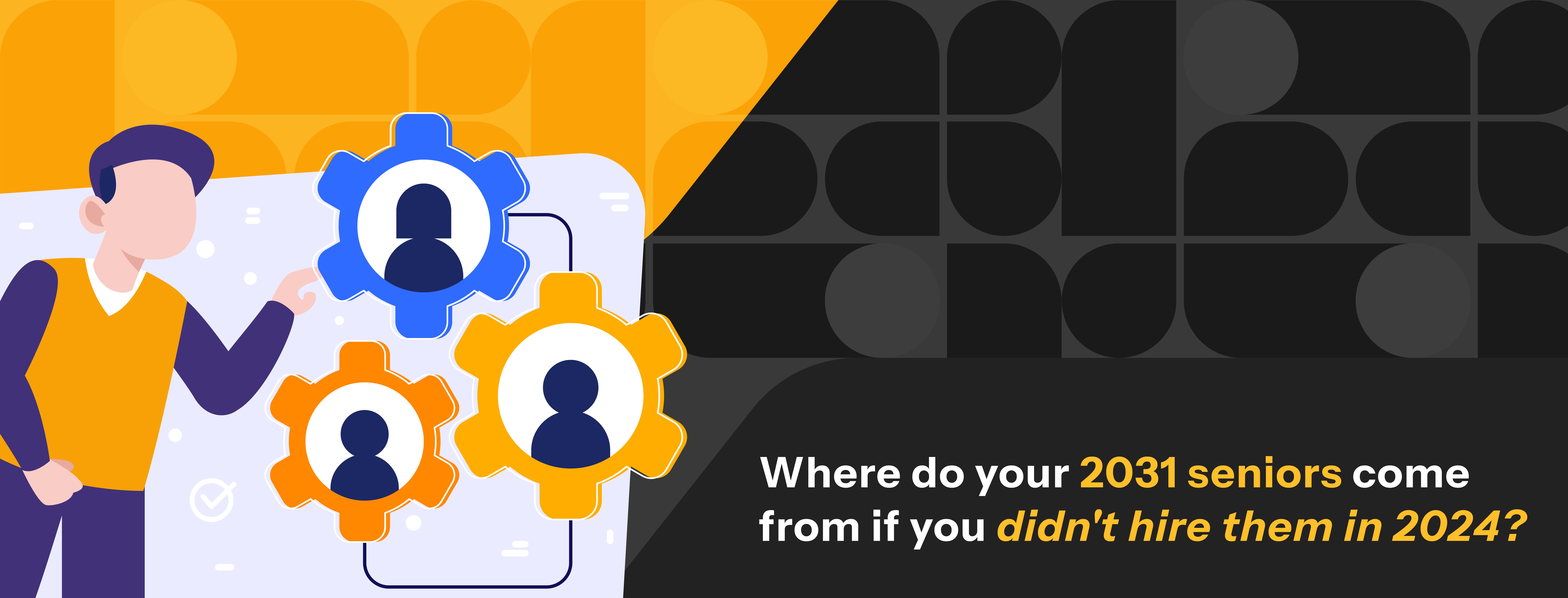


You're Saving Money on Junior Hires. You'll Pay for It by 2030.
In 2019, new graduates made up about 32% of Big Tech hires. Today that number is closer to 7%. Entry-level tech hiring across the industry has dropped roughly 73% in the past year alone. If you are a VP of Engineering or a Head of Talent reading this, there is a decent chance you signed off on one of those cuts.
The math felt obvious. AI tools make senior engineers faster. A senior with Copilot can do the work that used to require two or three juniors. Training budgets take 12 to 18 months to pay back and the board wants ROI this quarter. So you froze junior headcount, redirected the budget, and moved on. Everybody did it. It made sense at the time.
Here is the part that does not show up on this quarter’s spreadsheet: every junior you did not hire in 2024 or 2025 is a mid-level engineer you will not have in 2028 and a senior you will not have in 2031. There is no shortcut around this. You cannot buy five years of engineering judgment off the shelf, and no AI tool produces it either.
AI Didn’t Do This. Interest Rates Did.
The story everyone tells is that AI made juniors obsolete. It sounds clean and it plays well in board meetings. But the timing does not support it. If AI had actually replaced junior engineers, the collapse would have started in late 2022 when ChatGPT launched. Instead, it accelerated in 2023 and 2024 when interest rates spiked and companies shifted from growth-at-all-costs to immediate profitability.
AI was the excuse. Economics was the driver. Managers looked at the $20 to $30 per month cost of a coding assistant and compared it to a $70K salary plus six months of ramp-up time, and the decision was easy. But that comparison only works if you think of junior engineers as code-producing machines. If you think of them as the only pipeline that produces future senior engineers, the math changes completely.
The Talent Pipeline Is Not a Metaphor
We say “talent pipeline” so often that it has lost its meaning. So let’s be specific. A junior engineer hired today spends roughly two years learning how your systems actually work in production. How they fail. How they recover. How the database behaves under real load versus what the documentation says. How the team makes tradeoffs between speed and safety. None of that knowledge exists in any training course or AI model. It only comes from doing the work, making mistakes, and getting feedback from people who have been there longer.
After two to three years, that person becomes a mid-level engineer who can own features independently. After five to seven years, they become the senior who reviews AI-generated pull requests, catches the architectural flaws, and makes the judgment calls that keep production running. That is the pipeline. It takes years, it cannot be compressed, and right now it is empty.
As Stack Overflow’s engineering team put it plainly: if you don’t hire junior developers, you’ll someday never have senior developers. That “someday” is closer than most companies think.
Your Seniors Are Already Feeling It
The junior freeze is not just a future problem. It is hurting your existing team right now. Without juniors to delegate lower-risk work to, your senior engineers are stuck doing everything: the architecture decisions and the routine implementations, the code review and the debugging. AI helps with some of that, but AI does not absorb the cognitive load of being the only person on the team who understands why the system was built this way.
We see this constantly with the teams we work with. Senior attrition is climbing, not because pay is bad but because the job has become unsustainable. They are reviewing more AI-generated code than ever, with no one to share the load. The irony is sharp: companies cut juniors to make seniors more productive, and instead made seniors more burned out.
The Bidding War You’re Walking Into
Here is what 2029 and 2030 look like if nothing changes. The senior engineers who were 30 in 2020 are now 40 and being recruited for leadership roles or leaving for less intense work. The mid-level cohort is thinner than it has ever been because the juniors who should have fed into it were never hired. And every company in your market is competing for the same shrinking pool of experienced people.
When that happens, compensation explodes. Not 10 or 15 percent adjustments. Bidding wars. The kind of salary inflation that makes today’s “savings” from cutting junior hiring look absurd by comparison. We have seen this cycle before in cybersecurity, in data engineering, and in DevOps. When the industry ignores a pipeline for long enough, it pays a premium later that is five to ten times what it would have cost to build the talent internally.
What Smart Companies Are Doing Instead
The companies that will have the best engineering teams in 2030 are not the ones hiring the most seniors right now. They are the ones who figured out a new model for developing early-career talent that works within today’s economics.
That means rethinking what juniors actually do. The old model was hiring juniors to write boilerplate code. AI does that now, fine. The new model is hiring juniors to audit AI-generated code, to learn systems by reviewing pull requests alongside seniors, and to build judgment by working on real production systems with appropriate guardrails. The training ground changed but the need for training did not disappear.
It also means working with partners who can compress the ramp-up time. Instead of hiring raw graduates and spending 12 months getting them productive, you bring in people who have already been through structured, project-based training that mirrors real engineering work. They arrive with fundamentals, AI fluency, and enough production exposure to contribute from week one. That is a different proposition than the old “hire and hope” model.
That is exactly what TechX builds. Our programs do not produce coders. They produce engineers who have done real project work, reviewed real code, and built judgment alongside experienced practitioners. If you are thinking about how to rebuild your talent pipeline without going back to the 18-month ramp-up model, we should talk.
Navigate the innovation curve
Stay ahead with exclusive insights and partnership opportunities delivered directly to your inbox.
Stay Ahead of the Curve
in Tech & AI!
Get actionable insights across AI, DevOps, Product, Security & more—delivered weekly.