
- Solutions
Bridging innovation today
For Companies
Swift talent deployment, optimized resources, better results, and greater innovation.

For Universities & Organizations
Transform graduates into game-changers, build your legacy, and drive real impact.
For Aspiring Professionals & Students
Learn what gets you hired—build skills that matter.
For Companies
Swift talent deployment, optimized resources, better results, and greater innovation.
For Universities & Organizations
Transform graduates into game-changers, build your legacy, and drive real impact.
For Aspiring Professionals & Students
Learn what gets you hired—build skills that matter.
For Companies
Swift talent deployment, optimized resources, better results, and greater innovation.
For Universities & Organizations
Transform graduates into game-changers, build your legacy, and drive real impact.
For Aspiring Professionals & Students
Learn what gets you hired—build skills that matter.
- Impact
- About us
- Insights
- Contact us
- Careers
- English
- Solutions
Bridging innovation today
For Companies
Swift talent deployment, optimized resources, better results, and greater innovation.
For Universities & Organizations
Transform graduates into game-changers, build your legacy, and drive real impact.
For Aspiring Professionals & Students
Learn what gets you hired—build skills that matter.
For Companies
Swift talent deployment, optimized resources, better results, and greater innovation.
For Universities & Organizations
Transform graduates into game-changers, build your legacy, and drive real impact.
For Aspiring Professionals & Students
Learn what gets you hired—build skills that matter.
For Companies
Swift talent deployment, optimized resources, better results, and greater innovation.
For Universities & Organizations
Transform graduates into game-changers, build your legacy, and drive real impact.
For Aspiring Professionals & Students
Learn what gets you hired—build skills that matter.
- Impact
- About us
- Insights
- Contact us
- Careers
- English


Vibe vs Traditional Coding: How Do They Compare
In the ever-evolving landscape of software development, the emergence of innovative coding paradigms often sparks debate and curiosity among technologists. One such paradigm that has gained attention in recent years is “vibe coding”. But what exactly is vibe coding, and how does it compare to traditional coding methods?
Vibe coding is a relatively novel concept, characterized by its emphasis on intuitive and fluid development processes. At its core, vibe coding seeks to transcend conventional programming boundaries by fostering an environment where creativity and instinct guide the coding process. This approach integrates elements of improvisation and real-time feedback, often leveraging AI and machine learning tools to adapt and enhance coding in an organic manner. The goal is to create a seamless interaction between the coder and the machine, allowing for a more natural and less rigid coding experience.
Characteristics of Vibe Coding
- 🔹 Intuitive Interfaces
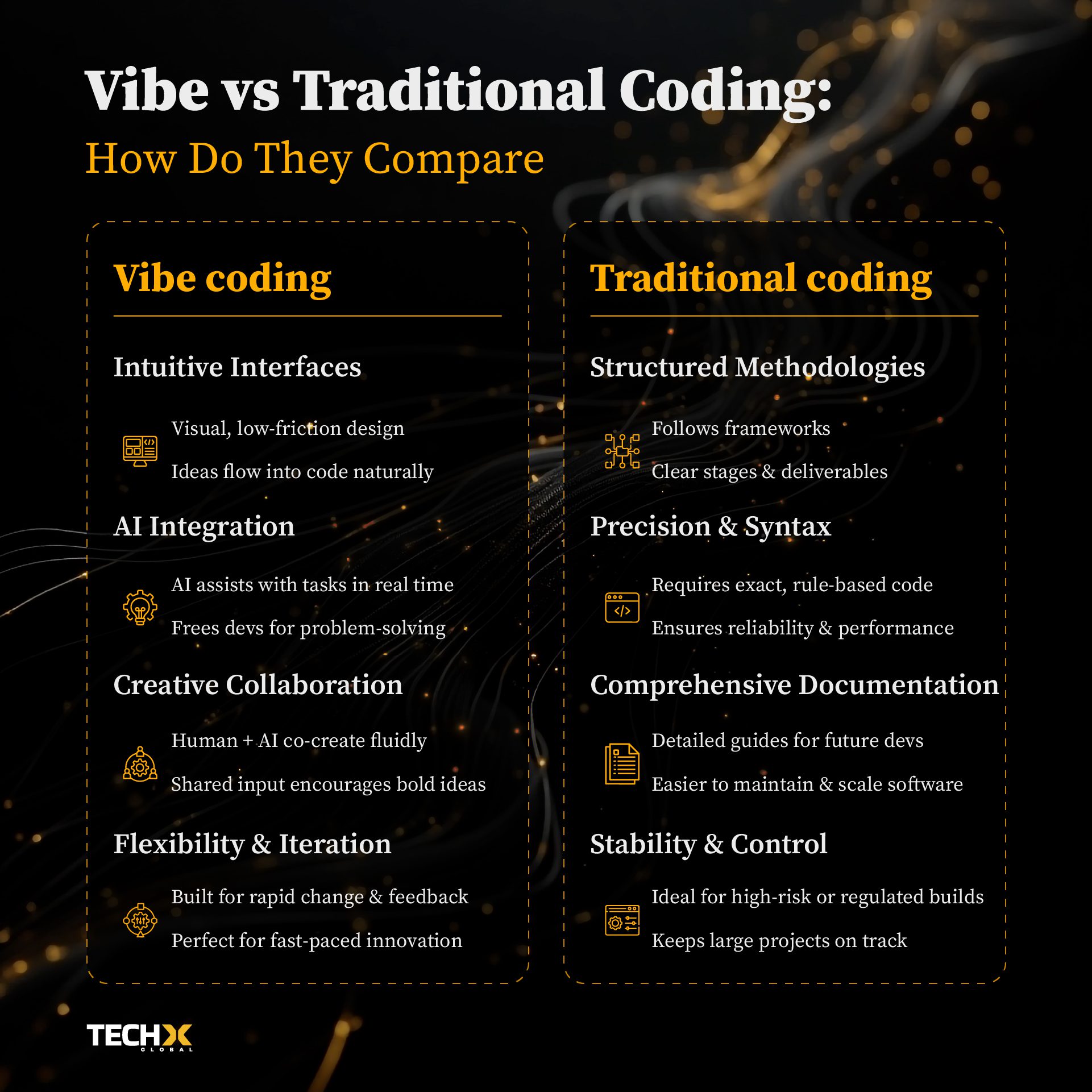
Vibe coding uses highly visual, interactive interfaces that reduce mental load—making it easier to turn ideas into code. Developers can focus on creativity instead of technical details. - 🔹 AI Integration
AI acts as a smart coding partner—offering real-time help, fixing errors, and handling repetitive tasks. It frees up developers to focus on big-picture problem-solving. - 🔹 Collaborative Environment
Vibe coding supports dynamic teamwork between humans and AI. It enables shared input, faster progress, and a stronger sense of community in the development process.
Traditional Coding: A Tried and Tested Approach
Traditional coding, on the other hand, is rooted in structured methodologies and well-established practices. This approach is characterized by its reliance on systematic planning, precise syntax, and comprehensive documentation. Traditional coding methods have stood the test of time, providing a reliable framework for developing robust and maintainable software solutions.
Key Characteristics of Traditional Coding
- 🔹 Structured Methodologies
Traditional coding follows frameworks like Agile or Waterfall, offering clear stages and deliverables. This structure keeps teams focused and projects on track. - 🔹 Precision and Syntax
It demands exact code and strict syntax—ensuring reliability, performance, and easy maintenance across systems. - 🔹 Detailed Documentation
Thorough documentation provides insight into architecture and design, making it easier to maintain, update, and scale software over time.
Comparative Analysis
🔸 Flexibility vs. Structure
Vibe coding embraces flexibility—perfect for fast-paced, evolving projects. It thrives on iteration and real-time feedback, ideal for rapid prototyping and creative flow.
Traditional coding sticks to structure—suited for precision-heavy, stable projects. Rigid frameworks help keep large or regulated builds on track.
🔸 Creativity vs. Precision
Vibe coding fuels experimentation. With AI tools offering fresh insights, developers can explore bold, unconventional solutions.
Traditional coding focuses on accuracy. Every line follows strict rules, ensuring systems are stable, reliable, and built to spec—especially in high-stakes environments.
Integrating Vibe Coding and Traditional Coding
For tech startup founders, the decision between adopting vibe coding or sticking with traditional coding methods need not be binary. Instead, the most effective approach may involve integrating elements of both paradigms to create a hybrid development environment. By leveraging the strengths of each approach, teams can optimize their development processes and foster a culture of innovation and excellence.
Conclusion
In the evolving realm of software development, understanding and leveraging diverse coding paradigms can provide a competitive edge. Vibe coding and traditional coding each offer unique benefits and challenges, and by thoughtfully integrating these approaches, tech startup founders can drive innovation, optimize operations, and achieve their strategic goals. As technology continues to advance, the ability to adapt and experiment with new methodologies will remain a key driver of success in the tech industry. Embracing a hybrid approach allows teams to harness the best of both worlds, creating a dynamic and resilient development environment that is poised for future growth and success.
Navigate the innovation curve
Stay ahead with exclusive insights and partnership opportunities delivered directly to your inbox.
Stay Ahead of the Curve
in Tech & AI!
Get actionable insights across AI, DevOps, Product, Security & more—delivered weekly.