
- Solutions
Bridging innovation today
For Companies
Swift talent deployment, optimized resources, better results, and greater innovation.

For Universities & Organizations
Transform graduates into game-changers, build your legacy, and drive real impact.
For Aspiring Professionals & Students
Learn what gets you hired—build skills that matter.
For Companies
Swift talent deployment, optimized resources, better results, and greater innovation.
For Universities & Organizations
Transform graduates into game-changers, build your legacy, and drive real impact.
For Aspiring Professionals & Students
Learn what gets you hired—build skills that matter.
For Companies
Swift talent deployment, optimized resources, better results, and greater innovation.
For Universities & Organizations
Transform graduates into game-changers, build your legacy, and drive real impact.
For Aspiring Professionals & Students
Learn what gets you hired—build skills that matter.
- Impact
- About us
- Insights
- Contact us
- Careers
- English
- Solutions
Bridging innovation today
For Companies
Swift talent deployment, optimized resources, better results, and greater innovation.
For Universities & Organizations
Transform graduates into game-changers, build your legacy, and drive real impact.
For Aspiring Professionals & Students
Learn what gets you hired—build skills that matter.
For Companies
Swift talent deployment, optimized resources, better results, and greater innovation.
For Universities & Organizations
Transform graduates into game-changers, build your legacy, and drive real impact.
For Aspiring Professionals & Students
Learn what gets you hired—build skills that matter.
For Companies
Swift talent deployment, optimized resources, better results, and greater innovation.
For Universities & Organizations
Transform graduates into game-changers, build your legacy, and drive real impact.
For Aspiring Professionals & Students
Learn what gets you hired—build skills that matter.
- Impact
- About us
- Insights
- Contact us
- Careers
- English
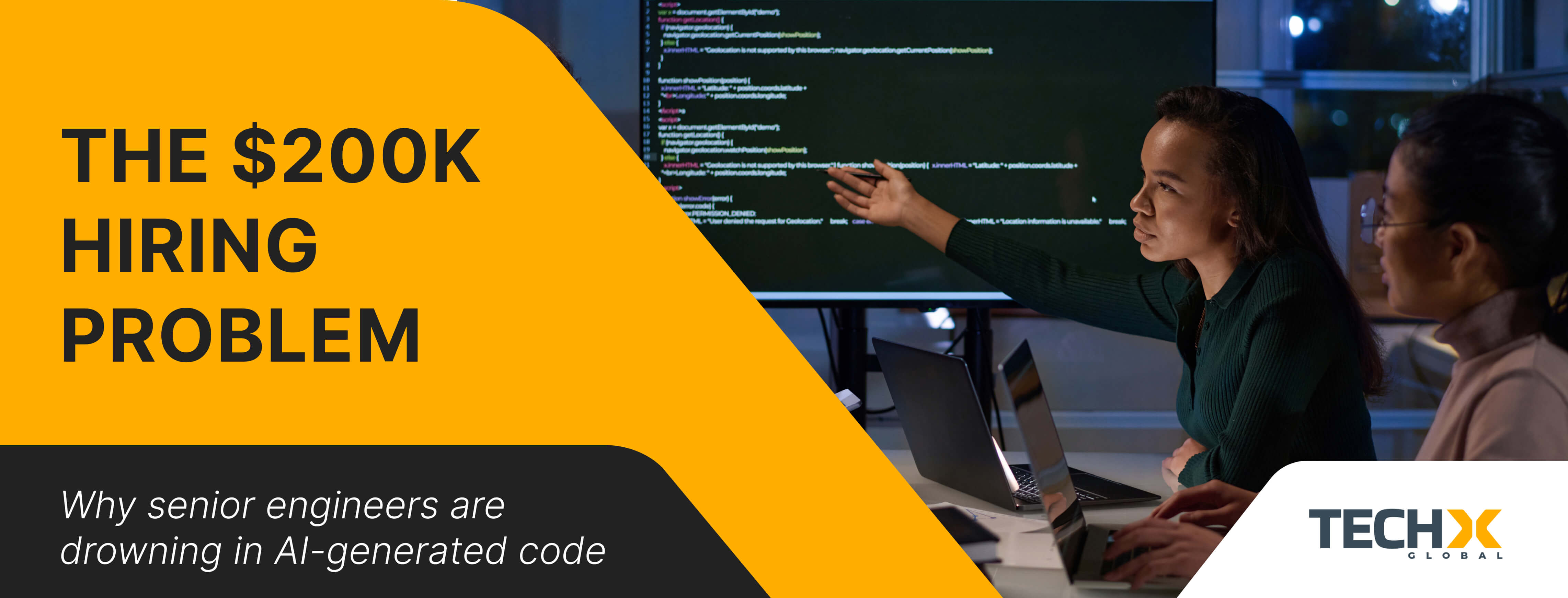


The Post-Review Engineer: The $200K Hiring Problem Nobody Is Solving
The tech industry has misidentified its biggest hiring problem. Every recruiter is scrambling for “senior engineers who understand AI.” Every job description screams for architects and systems thinkers. But that’s not where the bottleneck actually is. The real crisis is this: we have a massive shortage of engineers who can live in a world where 70-80% of code they touch was written by a machine they’ve never met.
The Almost-Right Problem
This is not a romantic problem. It’s not about “understanding AI” in some ethereal sense. It’s about operational sanity. A Harvard study tracking 62 million workers found something deceptively simple: when companies adopt generative AI, senior employment barely moves while junior employment collapses. Everyone assumes this is good news for seniors. It’s not. Seniors now drown in AI-generated pull requests that are algorithmically almost perfect but logically lethal.
Senior engineers today face a new form of cognitive torture. They inherit pull requests 150% larger than five years ago. Each one has been generated by a model that is deeply competent at syntax and genuinely dangerous at architectural judgment. The code looks right. It passes linters. Half the tests pass. But it makes assumptions about database transactions that would cause data loss in production, or it invents security mitigations that don’t actually exist. Reviewers can’t spot-check anymore; they have to verify every logical claim from first principles. Without having written the code, they’re reverse-engineering someone else’s confidence.
This is the “Almost Right” problem, and it is not a solvable problem through better tools. No linter will catch a race condition designed with beautiful, clean logic. No static analyzer will know that your code violates your company’s specific data governance rules. A machine cannot tell whether an API call has acceptable latency characteristics for your specific use case.
Who Actually Fills This Gap?
What emerges, then, is not a need for more senior architects, but a need for a specific type of engineer: the Post-Review Engineer. This is someone who has developed an operational comfort with ambiguity. They don’t need to have written the code to own it. They can read AI-generated implementations with a skeptical eye that isn’t paranoid but isn’t naive. They understand system-level implications and can mentally simulate failure modes. Critically, they don’t get exhausted by this work. They don’t experience code review as a burden that makes them want to leave the profession.
The irony is brutal: companies are cutting junior hiring because “AI can do what they do,” not realizing they’re destroying the only pathway to creating Post-Review Engineers. You cannot become someone who can govern complex code without first spending thousands of hours writing simple code. You cannot develop the pattern recognition needed to spot subtle architectural flaws without having committed architectural flaws yourself. The muscle memory of failure is irreplaceable.
How to Actually Identify Them
But here’s where hiring is actually broken. Post-Review Engineers can’t be identified through a standard technical interview. You can’t LeetCode your way into this skill. Someone who aces a system design round might completely fail at the specific task of “read this AI-generated code that claims to do X, decide whether you trust it.” The evaluation criteria are orthogonal to what companies actually test for.
A Post-Review Engineer has these actual attributes: they’ve shipped broken code and had to fix it. They understand the specific ways their company’s systems fail. They’ve spent time in incident response, not because they love firefighting, but because they learned how systems actually break. They read code they didn’t write and ask the questions that matter: “What happens when this assumption becomes invalid?” “How would I test this in production?” “What would an attacker do with this logic?”
This is someone who has survived enough chaos to have developed judgment. And judgment cannot be faked. It cannot be tested in a forty-five minute interview. It can only be earned through thousands of hours of exposure to reality.
The Hiring Inversion
The hiring market has inverted in a way nobody is talking about. The shortage isn’t of brilliant architects; it’s of battle-hardened engineers who can operate at scale in an environment where they’re constantly living with uncertainty. Where the code wasn’t written by someone they can Slack. Where the margin between “move fast” and “move fast and break critical systems” is tissue-paper thin.
Companies are still hiring for the old economy, where velocity meant “write more code.” Now velocity means “process more AI-generated code without letting catastrophic bugs through.” That’s a completely different hiring profile. And it’s not about raw technical intelligence. It’s about operational maturity.
Until hiring teams recognize that the bottleneck is verification capacity, not code generation capacity, they will continue making the same mistake: hiring more architects and designers when they actually need more engineers who can live comfortably in the space between “move fast” and “ship garbage.”
The True Value Proposition
The irony completes itself: the most valuable engineer in 2026 is not the one who can build the most elegant system from scratch. It’s the one who can inherit an AI-generated system they didn’t architect, understand its risks in thirty minutes, and make the call about whether it ships or burns down. That skill is rarer than any amount of Leetcode excellence. And almost nobody is hiring for it.
This is the gap TechX specializes in closing. We don’t train coders. We prepare verification architects—engineers with the judgment, operational experience, and system-level thinking required to govern the agentic economy. If your team is drowning in review cycles and struggling to move fast without breaking systems, the bottleneck isn’t your junior developers. It’s your verification capacity.
Navigate the innovation curve
Stay ahead with exclusive insights and partnership opportunities delivered directly to your inbox.
Stay Ahead of the Curve
in Tech & AI!
Get actionable insights across AI, DevOps, Product, Security & more—delivered weekly.